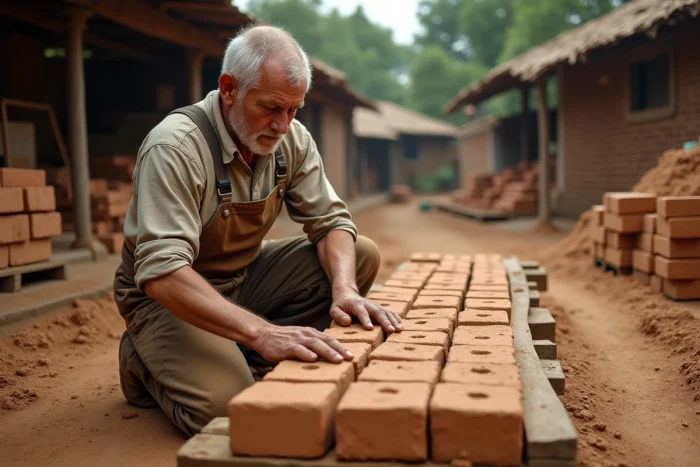
Rapid drying weakens the brick, but excess moisture during molding can lead to cracks invisible to the naked eye. Some clay soils, though considered ideal, prove unusable without the addition of sand or straw.
Proven manual techniques allow for the production of good bricks without resorting to any industrial machinery. It all depends on the rigorous selection of raw materials and the attention given to each step, without improvisation.
Why clay remains the heart of brick: a millennia-old material with multiple advantages
The clay brick does not dominate the construction site by chance. Since ancient times, this raw material has accompanied builders around the world: it is easy to work with, abundant in nature, and endures through the centuries without weakening. It can be found in the walls of villages, ancient temples, and modern neighborhoods. Fired, it becomes terracotta, solid against frost, stable against humidity, and virtually indestructible. In terms of comfort, clay brick naturally regulates indoor temperature, limits heat loss, and absorbs ambient moisture. The result: a healthy, consistent, reliable atmosphere.
Respect for the planet is also a priority. Extracted close to the construction site, clay reduces environmental impact. After use, bricks can be reused or recycled, extending the life of materials. Sand helps strengthen the cohesion of certain mixtures, while straw provides additional insulation as needed.
Brick making at Maisonea follows this lineage. At every stage, the precision of the gesture and the intimate knowledge of the raw materials are highlighted, as well as the importance of drying. The types of bricks are varied: solid, hollow, hand-molded, each finds its place, from the roof to the arch, from the main wall to the simple partition. This is why, despite trends, clay brick transcends eras and fits into all architectural styles without ever losing its relevance.
What tools and ingredients are needed to make your own clay bricks at home?
To embark on the handcrafted brick making, clay remains the essential base. Moisturized, it can be easily worked by hand or with a rudimentary mold. No need for sophisticated tools: a few everyday accessories are sufficient. A shovel for collecting and mixing the soil, a bucket for water, a sieve to eliminate gravel, a trough to properly amalgamate the ingredients. The mold, whether wooden or metal, just needs to be sturdy and suited to the desired size for your bricks.
Some choose to add a handful of sand to the mixture to strengthen the structure and avoid cracks during drying. If necessary, a bit of cement can make the brick even more durable, although this practice remains rare in traditional methods. The first operation consists of carefully kneading the clay with water until a homogeneous paste is obtained, which is neither too dry nor too sticky.
Here are the ingredients to prepare for a balanced mixture:
- pure clay or clay that already contains some sand
- fine sand (useful for binding and lightening the mass)
- water (to be adjusted for the right consistency)
- cement (as an additive, for specific uses)
Making bricks at home is about proximity and ingenuity: simple tools, local materials, a know-how that refines with each attempt. Forget the machine, prioritize observation and patience at every step of the process.
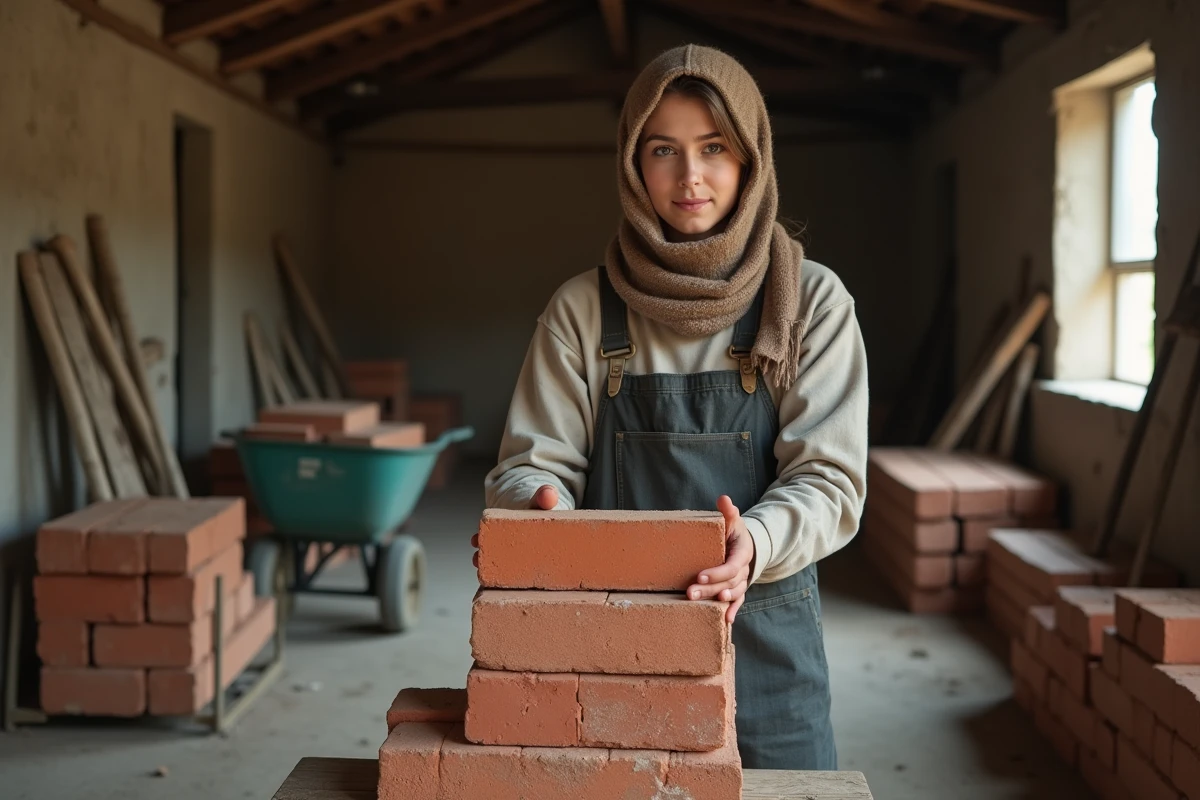
Detailed steps: from mixing to firing, everything you need to know to succeed in your artisanal bricks
Preparing the mixture: the foundation of a quality brick
All brick making starts with a careful mixture. The clay, previously sifted, is combined with a precise amount of water to form a pliable paste, neither too thick nor too liquid. Some add a bit of sand to limit shrinkage during drying and ensure the stability of the finished product.
Shaping and molding: precision and consistency
The paste is then placed in a slightly moistened mold, which prevents it from sticking. Careful smoothing, regular compacting, and gentle demolding are the key gestures to master. The freshly formed bricks are laid flat on a well-draining surface, ready to begin their evolution.
Two major steps finalize the artisanal production:
- Drying: a sensitive moment. The bricks must dry slowly in the open air, protected from rain and direct sunlight. This patience limits the risk of cracks and prepares for firing.
- Firing: once dry, the bricks are placed in a kiln or suitable hearth. It is the heat that transforms the clay into terracotta, ensuring strength and longevity.
The temperature and duration of firing directly influence the quality of the result. If not fired enough, the bricks remain brittle; if overcooked, they become fragile. Strict adherence to each phase of the manufacturing process makes all the difference in obtaining authentic bricks, ready to withstand the test of time.
In the end, it all comes down to hand and eye: experience refines the gesture, time reveals the accuracy of the process, and each brick that comes out of the batch tells a story of materials, patience, and ingenuity.