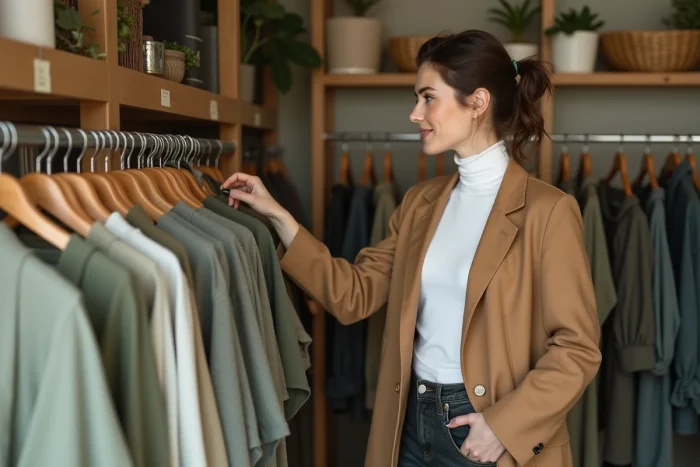
The choice of trendy and responsible clothing is not just about avoiding fast fashion or sorting your wardrobe. The real challenge lies in the ability to build a wardrobe that absorbs the erratic European climate variations while maintaining a stylistic coherence and a commitment to textile supply chains.
Regenerated fibers and organic cotton: balancing real textile performance
Organic cotton remains the default reflex when thinking about responsible fashion. It’s a reasonable choice, but regenerated fibers like Lyocell surpass organic cotton in water footprint, according to the comparative analysis by ADEME published in January 2026. Since mid-2025, premium brands have been adopting these fibers at an accelerated pace.
Lyocell, derived from sustainably managed wood, offers a fluid drape suitable for both a light dress and structured trousers. Its natural thermoregulation makes it a textile particularly suited for transitional seasons, where cotton shows its limits. Specialized platforms like quali-mode.fr help identify pieces made from these technical materials without multiplying searches.
We recommend checking three elements before purchasing a piece made from regenerated fiber:
- The FSC or PEFC certification of the source wood, which guarantees regulated forest management and not just a marketing claim
- The closed-loop manufacturing process (solvent recovery), which distinguishes Lyocell from conventional viscose
- The fabric weight, dense enough for a durable piece but fine enough to remain wearable from March to October

Responsible wardrobe and climatic micro-seasons: the real technical constraint
Sustainable fashion guides still resonate with two seasons, sometimes four. The current European climate imposes brutal transitions: heat waves in March, cold returns in May, autumns stretching into December. A responsible wardrobe must function through modular layering, not seasonal rotation.
The logic of technical layering changes the way pieces are selected. A blended Lyocell blazer worn over an organic cotton t-shirt, itself combined with a fine merino underlayer: three layers that cover a wide thermal spectrum without multiplying purchases. The goal is to reduce the total number of garments owned while increasing the number of wearable combinations.
Building a core of versatile pieces
The core of a wardrobe suited to micro-seasons relies on pieces whose cut and material allow for isolated or layered wear. A straight-cut organic cotton twill pant works the same way in April with sneakers as it does in November with ankle boots and a coat.
Favoring neutral colors for the core (ecru, navy, khaki, heather gray) is not a lack of boldness. It’s a strategy that allows for the integration of strong pieces, a printed jacket or a colorful dress, without creating incompatibilities in the wardrobe. Trendy style comes from proportions and associations, not from the accumulation of flashy pieces.
European textile regulation: what changes concretely in 2026
The European ban on the export of unsorted used textiles to developing countries came into effect in January 2026, in accordance with EU Regulation 2024/3190. This measure has a direct impact on how we must think about the lifecycle of a garment at the time of purchase.
Concretely, the European second-hand market will densify. Clothes you no longer wear can no longer be shipped in bulk to third markets without prior sorting. Two consequences for the informed consumer:
- The local resale of quality pieces gains more value, justifying the investment in garments whose material and construction allow for a second life
- Slow fashion brands that offer take-back or repair programs become a full selection criterion, beyond just an ethical label
- Domestic sorting becomes a technical gesture: separating resalable pieces, repairable pieces, and textiles to be recycled into fiber
Labels and certifications: reading beyond the pictogram
A GOTS label on a tag guarantees the traceability of organic fiber and working conditions. But it says nothing about the mechanical durability of the fabric or its suitability for prolonged wear. A certified garment that pills after five washes remains a failed purchase.
We observe frequent confusion between material certification and quality of construction. Checking seams, weaving density, and dye fastness remains a manual gesture that no label can replace. For knitted pieces, a simple test is to gently stretch the fabric: if it doesn’t return to its original shape, longevity will be poor.
Choosing clothes made in France or Europe: when proximity has a technical meaning
The label “made in France” on a garment does not automatically guarantee superior quality. However, it does guarantee traceability of the manufacturing process and, in most cases, verifiable social and environmental standards. The real advantage of European textiles lies in the responsiveness of small batches, which allows brands to produce based on actual demand rather than overproducing.
For a coherent responsible style, crossing the origin of manufacturing with the source of raw materials gives a more complete picture. A dress made in France from Austrian Lyocell (Lenzing) and dyed without heavy metals represents a short circuit on a European scale, with limited transport impact.
Responsible fashion does not require giving up on trends. It demands selecting pieces with the same rigor applied to other technical purchases. Material, construction, climate adaptability, regulatory framework: these four criteria effectively filter sustainable purchases from those simply labeled “eco”.