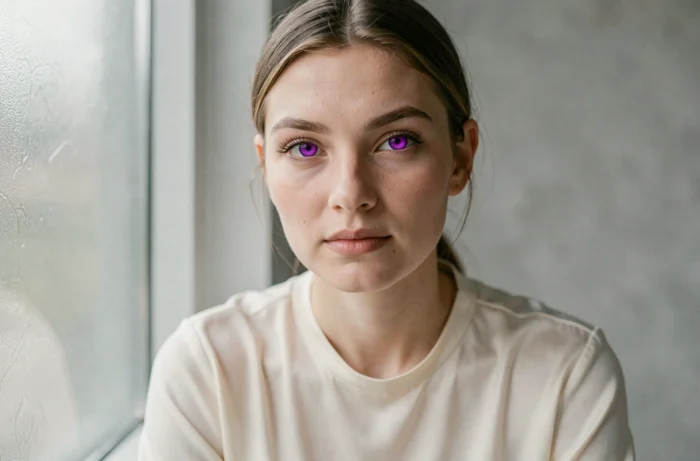
No medical publication has documented a human iris with stable pigmentation that is pure violet. What we call “violet eyes” corresponds to an optical continuum where the low concentration of melanin in the iris stroma, combined with Rayleigh scattering and lighting conditions, produces a variable blue-violet perception. Understanding this mechanism helps to untangle the myth of celebrities with violet eyes from physiological reality and to identify the cosmetic levers that reproduce this effect.
Rayleigh Scattering and Stroma Melanin: Why the Iris Appears Violet
The color of the iris depends on two parameters: the amount of melanin in the anterior stroma and how light scatters within it. A heavily pigmented iris absorbs most wavelengths and appears dark brown. A very lightly pigmented iris allows Rayleigh scattering to reflect shorter wavelengths, resulting in a blue appearance.
The shift towards violet occurs when an extremely reduced stroma melanin allows for the simultaneous scattering of blue and reveals, through the interplay of retro-iris vascularization, a reddish component. This blue-red optical mix produces a hue perceived as violet or purple, without any violet pigment existing in the ocular tissues.
Several genes modulate this outcome. Variants of OCA2 and HERC2 influence the amount and distribution of melanin. Their interaction explains why two blue-eyed parents can have a child whose iris leans towards gray-violet in certain lights, while the phenomenon is absent in the parents.
As detailed in Beauty Inc’s beauty articles, this hue is so unstable that it changes depending on the angle of observation, the color temperature of the lighting, and even the makeup worn around the eyes.
Elizabeth Taylor and the Color of Her Eyes: Deep Blue or Real Violet
The most cautious description of Elizabeth Taylor’s eyes is “deep blue” or “blue-violet”, not pure violet. On-set photographs show an iris whose hue varies significantly from one film to another, from one photographer to another.
Several technical factors amplify the violet impression:
- Costumers regularly chose white or lavender outfits that, through simultaneous contrast, enhanced the perceived violet component in the iris.
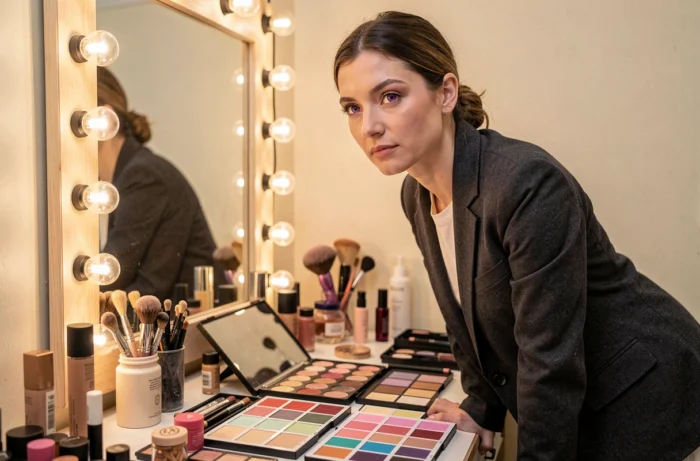
- On-set makeup, particularly gray-mauve eyeshadows and dense black mascara, created a chromatic framework that directed the reading of the iris color towards violet.
We observe the same phenomenon in contemporary beauty photography: a light blue iris, surrounded by plum eyeshadow and illuminated by warm tungsten light, appears lilac in the final shot. The iris has not changed pigmentation; only the visual context has shifted.
Ocular Albinism and Violet Iris: A Distinct Medical Case
Ocular albinism is the only clinical setting where an iris can actually appear violet recurrently. When melanin is almost absent, the iris becomes sufficiently translucent for the retro-iris blood vessels to become visible. The overlay of blue scattering and vascular red gives a pink, red, or violet appearance depending on the degree of residual pigmentation.
This mechanism has nothing to do with a “violet eyes gene.” It results from a global deficiency in the melanin synthesis pathway, with functional consequences: photophobia, nystagmus, decreased visual acuity. Associating ocular albinism with a mere aesthetic trait would be a misreading of the medical context.

Eye Makeup and Colored Contact Lenses: Reproducing the Violet Eye Effect
Since natural violet remains a contextual perception rather than a fixed pigmentation, cosmetic techniques exploit exactly the same optical levers to reproduce it.
Eyeshadows and Mascara for a Violet Look
The principle is based on chromatic contrast. An eyeshadow in plum, eggplant, or mauve tones, applied to the mobile eyelid and blended in a banana shape, alters the perception of the iris color through neighboring effects. On a light blue or gray iris, the violet effect is almost immediate.
Black mascara remains the best ally: it darkens the lash line and prompts the viewer’s eye to perceive the iris as lighter and more saturated. Brown mascara on a hazel iris produces a softer result, shifting towards bronze rather than violet.
Colored Contact Lenses and Regulation
Colored lenses are not just beauty accessories. In the United States, the FDA classifies them as medical devices requiring a prescription. A prior consultation is recommended to check the corneal curvature and appropriate diameter.
Opaque violet lenses completely cover the natural color of the iris and are suitable for dark irises. Semi-transparent “enhancement” lenses work only on light irises and produce a more natural result, close to the contextual blue-violet described above.
Genesis of Alexandria: The Persistent Urban Legend
According to this myth, a rare genetic mutation would cause violet eyes from birth, accompanied by pale skin, lack of body hair, and exceptional longevity. No scientific basis supports this claim.
The story checks all the boxes of an urban legend: untraceable origin, biologically incoherent symptoms, total lack of clinical documentation. The success of this myth lies in the allure of violet as a rare color and the fascination with unusual physical traits attributed to celebrities.
Violet in the human iris remains an optical phenomenon, not a pigment. Whether discussing Elizabeth Taylor, ocular albinism, or beauty makeup, the mechanism is always the same: an interaction between light, melanin, and visual context. Seeking a “true” violet iris is akin to searching for a pigment that does not exist in the iris tissue, which does not detract from the aesthetic power of this perceived color.