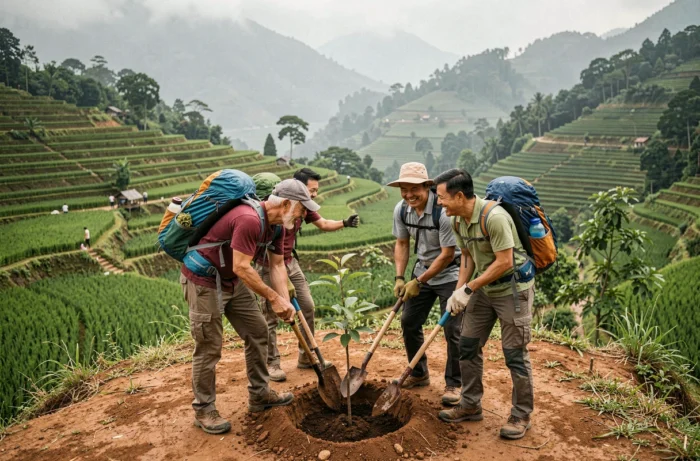
Solidarity tourism is more than a marketing label attached to exotic tours. It is a contractual framework between operators, host communities and travellers, with mechanisms for redistributing revenue, long-term commitments and local governance criteria. The initiatives shaping the sector today are changing the financial flows generated by travel, not just its image.
Financial redistribution mechanisms in solidarity tourism
The central issue in solidarity tourism remains the traceability of the revenue generated by travellers. In the most developed models, a contractually agreed share of the cost of a stay goes directly into a local development fund managed by the host communities themselves.
This approach differs from conventional tourism, where most spending is captured by intermediaries such as airlines, booking platforms and international hotel chains. The National Union of Tourism Associations (UNAT), which defined solidarity tourism in 2006, places this fair redistribution of travel revenue at the heart of its definition.
In practice, organisations operating under this model work with partner villages or neighbourhoods to decide how the funds will be used: building school facilities, purchasing agricultural equipment or funding community health insurance schemes. Travellers are not merely spectators of a project; simply by staying there, they help co-finance it. To follow the latest news from Le Voyageur Solidaire, several networks document these mechanisms in real time, making it possible to verify exactly how the funds are allocated.
The goal is not a one-off act of generosity. It is the long-term sustainability of partnerships between operators and communities, built over several years and supported by shared assessments.

Fair tourism and local governance: who makes decisions on the ground?
A well-designed solidarity tourism stay does more than give money back. It transfers some decision-making power to host communities. This is the structural difference between solidarity tourism and charity tourism, where travellers fund a project designed by outsiders.
In the most rigorous initiatives, villagers help design the tourism programme. They decide what visitors can see, what remains private, when guests are welcome and the maximum number of visitors. This shared governance protects cultural heritage as well as the community’s social balance.
- Village committees approve or reject itinerary proposals submitted by partner operators, ensuring that sacred spaces and agricultural seasons are respected.
- Guides and tour leaders are recruited locally, trained on site and paid according to rates negotiated with local development associations.
- Homestays follow a set of minimum standards covering hygiene, comfort and capacity, jointly drawn up by the community and the operator to prevent standards from being imposed from outside.
This model requires a considerable investment of time before a destination can be launched. We find that the strongest organisations often spend several years working with communities before welcoming their first group.
Travel sustainability indicators: looking beyond visitor numbers
The European Union now aims to assess tourism by more than visitor numbers alone. This shift in perspective, driven by the European sustainable tourism strategy, moves the debate towards lasting benefits and how they are shared across regions.
This perspective is crucial for solidarity tourism. A village welcoming around twenty travellers a year can generate a greater socio-economic impact than a natural site visited by thousands, provided that revenue is redistributed effectively.
European guidance on Natura 2000 sites also points out that tourism can bring socio-economic benefits, but these depend on preserving the ecological resources that make such stays possible. Balancing local income with environmental protection remains the main point of tension in natural areas.
What conventional indicators fail to measure
The occupancy rate of a solidarity tourism accommodation does not mean the same thing as that of a hotel. A deliberately capped occupancy rate may reflect a decision to protect the local way of life, not a commercial failure.
Similarly, the average length of stay matters more than visitor volume. Solidarity travellers stay longer, spend locally and sometimes return year after year. This loyalty creates a stable economic relationship, preferable to the seasonal peaks of conventional tourism.
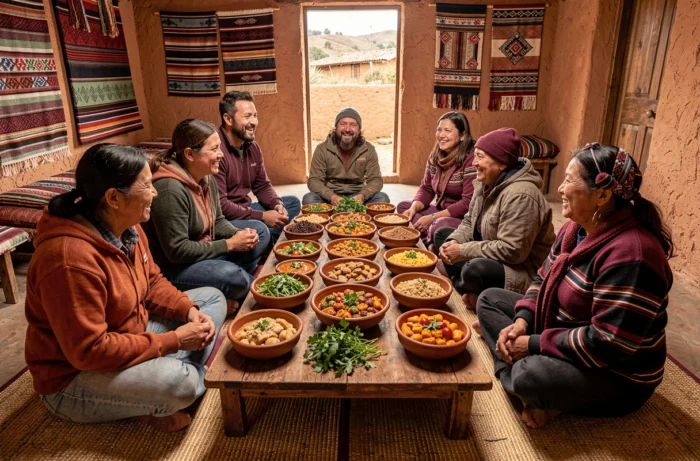
Green transition for small solidarity tourism businesses
European monitoring reports environmental progress in the tourism sector, but also highlights a lag in the practices of small businesses. Support for their green transition remains limited, leaving solidarity tourism organisations, which are often small, particularly vulnerable.
Successful solidarity initiatives tend to make their ecological transition through practical local measures rather than regulatory compliance: using locally sourced building materials, buying food for travellers through short supply chains and limiting motorised transport during stays.
- Homestays inherently reduce the carbon footprint of accommodation compared with air-conditioned hotel facilities.
- Meals prepared with local produce eliminate imported supply chains and showcase culinary heritage.
- Walking, cycling and local public transport replace private vehicle transfers, reducing the carbon impact of a stay once travellers arrive.
The challenge remains getting to the destination by air. A solidarity tourism trip to Togo or Kyrgyzstan involves a long-haul flight whose carbon footprint far exceeds the savings made on the ground. Some operators are beginning to include a carbon contribution in the price of a stay, but this practice is neither widespread nor standardised.
Solidarity tourism transforms the relationship between travellers and their host communities by establishing clear rules for sharing revenue and decision-making. The organisations that endure are those that invest as much in local governance as they do in promoting their trips. In the years ahead, the challenge will be less about attracting new travellers than about funding the ecological transition of these micro-businesses without overwhelming them with standards designed for the conventional hotel industry.