
Finding the right professional contacts in Brittany is not just about collecting business cards at a trade show. Networking is built over time, through regular exchanges and spaces where profiles naturally intersect. However, one must know where to focus their energy, especially when starting out or changing paths.
Brittany’s Networking Ecosystem: What Has Recently Changed
The landscape of entrepreneurial support in Brittany has been reconfigured. The association Entreprendre au Féminin Bretagne ceased its activities in February 2025, after 17 years of existence. This closure has reshuffled the cards.
Organizations like Femmes de Bretagne, BGE Bretagne, Réseau Entreprendre Bretagne, and France Active Bretagne now occupy part of the space left vacant. Women’s networking remains particularly structured, with local branches noted in Brest, Rennes, Lorient, Vannes, Quimper, and Saint-Brieuc.
The underlying trend is clear: Brittany’s networks are specializing by audience and format. A simple directory of contacts is no longer offered. Recent offerings combine local meetings, online communities, practical workshops, coaching, and business referrals. For a young professional or project leader, navigating this multitude of offerings requires understanding what each space concretely provides.
It is in this context that the business space on Jeune Bretagne offers an entry point focused on connecting local actors, targeting a young and entrepreneurial audience.
Online or In-Person Professional Network: Choosing the Right Lever
You may have noticed that some professional relationships arise from an informal exchange over coffee, while others are formed through a relevant comment on a platform? The two channels do not serve the same purpose.
In-Person to Build Trust
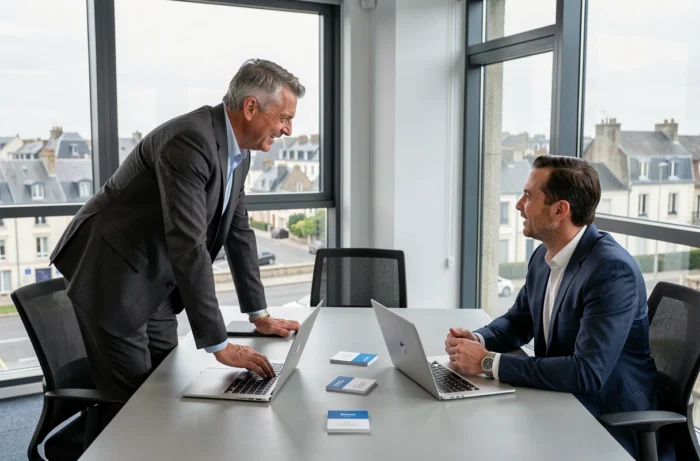
Physical meetings, whether workshops, entrepreneur clubs, or inter-company mornings, create a quicker bond. In Brittany, networks like BNI operate on this principle: local groups meet regularly to exchange business referrals.
In-person works better for service professions and local B2B. A craftsman in Vannes or a consultant in Rennes builds their clientele through word-of-mouth much more than through an online profile.
Digital to Expand the Scope
An online platform allows one to transcend geographical limits. A developer based in Morlaix can find a partner in Lorient without having to travel every week. Digital spaces dedicated to the Breton territory add a useful filter: they group profiles that share a common regional anchor.
The combination of both is often the most effective. Here’s how to articulate the two channels:
- Identify relevant profiles online, review their projects or displayed skills, then propose an exchange via video or in person
- Attend a local event, then extend the conversation on a dedicated platform to maintain contact
- Regularly publish content in your area of expertise to attract inbound inquiries, even between two physical events
Building a Useful Network in the Breton Territory: A Concrete Method
Having an account on a platform is not enough. A useful professional network relies on reciprocity. In other words, you must give before you receive.
Let’s take a simple example. You are a final-year student in Rennes looking for an internship in innovation. Instead of sending a generic message to twenty companies, start by identifying the key players in the sector in the area. Comment on their posts. Share a research article related to their field. After a few weeks, your name will become familiar.
Errors That Hinder Connections
Asking for a favor in the first message is the quickest way to be ignored. Professionals receive dozens of requests. What distinguishes a memorable contact is the relevance of the approach.
Another trap: spreading yourself too thin across too many networks at once. It’s better to be active on one or two well-chosen spaces than to maintain ghost profiles everywhere. A space focused on the Breton economic life will be more relevant than a global generalist network if your project is locally anchored.

Transforming a Contact into Collaboration
The transition from simple exchange to a joint project generally follows three steps:
- A first exchange around a shared topic (industry, campus, geographical location), without a direct request
- A deepening through a call or meeting, to understand mutual needs
- A concrete proposal, even modest (recommendation, introduction to a third party, participation in a joint event)
Every collaboration arises from an exchange where both parties find mutual interest. This principle applies to a recent graduate as well as to an established business leader.
Breton Professional Network: What Regional Platforms Offer
National or international platforms attract a considerable volume of profiles. Their limitation is precisely this volume: the noise drowns out the signal. When you are looking for a partner for a project in Brittany, filtering by region on a global network yields approximate results.
Territorially anchored digital spaces solve this problem. They group profiles already qualified by their connection to the territory: locally established businesses, project leaders seeking partners on-site, students from Breton campuses.
The territorial anchoring of a platform reduces prospecting time. You know that the profiles present share at least a geographical connection. The first filter is already done.
This type of space complements physical networks like entrepreneur clubs or incubators. It does not replace them, but it offers a digital continuity to relationships initiated on the ground. For a young professional in Brittany, combining both approaches remains the most direct path to a solid and actionable network.